Well, here it is:  the promised blog post on food and eating.  As some of you know, Brian and I have joked that there’s good and bad news about food in the Middle Kingdom.

Good news:  people eat EVERYTHING in China.
Bad news:  people eat EVERYTHING in China.

In general, this mantra has proven to be true.  We almost made the mistake recently of ordering “pig brain rice;” Fortunately, we wisened up and asked for the English menu before ordering a dish that we thought only said “pork rice” in Chinese!  One morning, we saw restaurant managers proudly carrying live ducks tethered to a pole back to their businesses, undoubtedly so that these poor fowl could soon meet their maker.  And a few days ago, Brian and I learned the hard way that the green vegetable soup we ordered actually had a menagerie of bone, fat, and skin. Oy!  
 
In addition to eating all types and parts of animals, the Chinese are becoming more and more open to Western food.  I was greatly relieved to discover upon arrival here that there are multiple cafes with excellent café au laits within walking distance (including our favorite Costa, which we describe in a previous post). We’ve found sandwich bread of decent quality (and even a Subway sandwich shop not too far away!), yogurt has become increasingly popular, Dove chocolate bars have secured a niche in the campus snack shop, and we know where to find good pizzas and hamburgers.  
 
For items that are a little more difficult to come by, there is a luxury imported food store about 45 minutes walking from campus.  The last time we went, Brian and I chowed down on an excellent salad mix they had.  We can find Italian coffee and cereal,
Korean canned tuna with kimchi sauce (quite tasty, actually!), barbeque sauce, flavored oatmeal, gourmet cheese, Betty Crocker yellow cake mix, tortilla chips, canned soup, British shortbread, German boxed milk. People from all over the world who now live in Hangzhou come to this store seeking some little taste of home! 

There are foods I already miss and have not found—chili/thick stews, homemade pancakes, pumpkin pie, salsa, lentils, quinoa, chickpeas, salmon fillets (I am hesitant to eat fresh fish here, and the fish that I can find is packed with bones).  So perhaps the Chinese don’t quite eat EVERYTHING.  We have definitely had some excellent meals, but we’ve also had to adjust our expectations based on availability and expense.  Western food is more expensive, and must be rationed.   
 
The hunt for nutritious, inexpensive, sanitary, and tasty food can be difficult at times.  So occasionally Brian and I crave a glass of wine or pint of beer! :)  While the Chinese aren’t known for their beer and wine, Western types of alcohol are becoming more
common.  Light beers are ubiquitous, but they are largely tasteless (and alcohol-less—on average only 2%).  We were ecstatic to discover that Tsingtao, the most famous Chinese brewery, makes a stout that is excellent and only about $1.50/bottle. 
This stout (and all stouts) are incredibly difficult to find, however--apparently the Chinese don’t like dark beers.  We stocked up on some yesterday!  :)

Though wine is increasingly common on menus, wine by the glass is almost nonexistent here.  The campus grocery store
actually has some bottles of inexpensive Chinese red wine, but I haven’t worked up the nerve to try it yet.  Stay tuned!  
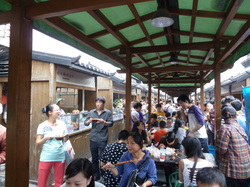
Picture
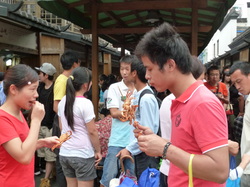
Street food on busy yet delightful Hefang Street, a lovely tourist area. 
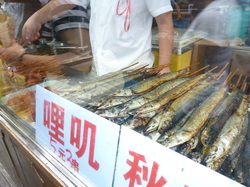
Picture
About $1 for 2!  Interested? :) 

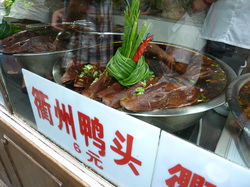
Picture
Yes, these are duck heads for sale ($1 each).  No, we did not eat any. 
Picture
Crab-on-a-stick, a local delicacy.  I may be adventurous enough to try this one day, but not yet.....
Picture
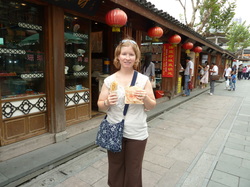
Eating an excellent vermicelli wrap and sandwich that has ground chicken, lettuce, and spices on bread that resembles an English muffin.  All for $2! :)
 
 
I thought I’d share a conversation I had a few days ago.  As I’m trying to expand my Chinese lexicon, I’m proud I was able to have this conversation in Chinese.  I also try to use the phrase “how do you say ____ in Chinese?” with everyone I encounter to learn new words. 

Scene:  the café on campus, which sells laundry tickets, cookies, cigarettes, snacks, and coffee out of a Nescafe machine. 

Melanie: (enters the door during a break between class)  Hello!  Do you have a cup of coffee with milk?

Shop clerk:  Yes, we have it.  (pushes the button on the Nescafe machine, waits for the coffee to emerge, and hands it to Melanie.) 

Melanie:  (takes a sip, and slips the clerk the 50 cents to pay for it.)  Thank you.  Do you have sugar?

Shop clerk:  No, we don’t have sugar.  But there is another drink that has sugar in it (points to a button in a column of buttons on the drink machine.) 

Melanie:  Oh?  (points to the same button in the column.)  How do you say that drink in Chinese?

Shop clerk:  “the first one.”

Melanie: (pauses to ponder this answer.  smiles.)  Thank you.  Good bye! 

Shop clerk(smiles.)  Good bye!

* I originally called this post "a typical Chinese conversation," but "typical" is probably too strong a word.  Conversations like this don't comprise a majority of those that we have with locals, but they do happen fairly often.  So maybe I'll stick with "occasional." :)


Firstly, this post won’t be about cooking.  I’ll write that one soon enough (I’m still on the search for cinnamon or pumpkin pie spice), but I want to go ahead and chronicle our weekend adventure while it is still fresh on my mind :). 

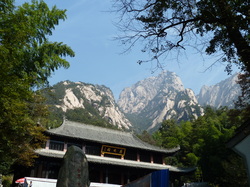
As I mentioned in my previous post, we traveled this past weekend to Huangshan ("yellow mountain").  Never heard of Huangshan?  Honestly, I hadn’t either until five days before we traveled there.  But if you’ve ever seen a Chinese wall scroll that has misty clouds and granite mountains on it, then you’ve seen Huangshan.  According to my handy Lonely Planet guidebook, Huangshan inspired an entire school of artists in the 17th and 18th centuries (hence the wall scrolls :). I can believe it.  The mountain and surrounding area are stunning.

Our new friend Tricia (who speaks pretty good Chinese and has traveled extensively in China) organized a trip of six people to Huangshan.  We picked up a bus first thing Friday morning (we didn’t have classes Friday, which is why we were motivated to travel in the first place) that took us to another bus for our journey out of the city.  Bus #2 was rather small and old—when my 5’2” self has knees knocking against the back of the seat in front of me, then we’re talking SMALL!  Nonetheless, the bus safely carried us the four hours through the verdant countryside, lush mountains, terraced landscapes, intriguingly empty stetches of newly built apartment/shopping buildings, and small farming communities that precede Huangshan. 

We arrived at your run-o’-the-mill sketchy trading post for a quick lunch and opportunity to buy snacks to carry up the mountain.  We scarfed down some lunch, and stocked up on dried tofu and green peas (both very common here).  We then headed to bus #3, which took us to the starting point to hike Huangshan. 

A few notes about Huangshan and hiking in China: 

  1. Any trail worth hiking in China has stairs.  And lots of them.  Sadly, my handy guidebook doesn’t say how many stairs comprise the trail up/down Huangshan, but I’m guessing somewhere between 2,000 and a ga-jillion.  Seriously.  This mountain is TALL, folks, and all stairs. 
  2. While we found ourselves increasingly winded and wobbly from the countless stairs, we had to continually dodge mountain porters who were hauling stuff up and down the mountain.  Here I am, supposedly in my prime of life and with my high fa-lootin’ footwear from the US, and these guys are whizzing by me while carrying two watermelons and 60 bottles of water, while only wearing tiny little shoes that look like pistachio green Keds.  Talk about a humbling experience. 
  3. The reason why these porters are whisking water and watermelons up and down the mountain is because there are no roads at the summit.  Only stairs (did I mention Huangshan has a lot of stairs? :).  Since there is no easy way to lug provisions to the summit, any food for sale up top costs mucho dinero.  I was especially glad our group could share snacks for dinner and breakfast once we arrived at the top!
  4.  A fair amount of Chinese hikers had some sort of portable boom box with them that played Chinese songs (honestly, many of the songs sounded like the ones I hear during Edification Hour*). 
  5. Sprinkled along the trail were “no smoking” signs.  How anyone could have the lung capacity to smoke and clamor up that mountain is beyond me. 
  6. “Clean” and “dirty” are relative terms in China.  When we first arrived at our dorm room in Hangzhou, I considered it incredibly dirty.  In comparison to Friday night’s hostel on the summit, however, our dorm is sparkling.  The hostel bathroom was a new level of nasty that I won’t deign to describe—luckily we didn’t have to stay there very long! :)
  7. While I still don’t comprehend much Chinese, I did understand when other hikers were guessing our nationality. We apparently look German, British, American, and some nationality called “le guo” (still not sure what country “le” is—“guo” means country).
The hike itself was incredibly strenuous—honestly, it’s one of the most challenging physical endeavors I’ve ever completed.  We hiked 13.5 miles to a summit more than a mile high in two days.  My leg muscles are still barking today! :)  Yet I appreciated the camaraderie that everyone on the trail shared.  Chinese tourist, foreign tourist, and porter alike encouraged each other with a supportive “jai you!,” which means, “you can do it!”  

The scenery was stunning.  Huangshan apparently has rain and fog at least 200 days/year.  Yet we were blessed with weather as idyllic as the climate we enjoyed in Shanghai—sunny, mild temperatures, and clear skies.  The leaves became increasingly colorful and vibrant the higher we climbed, and we relished a gorgeously clear night sky full of constellations (something I’ve seldom seen the past few years while living in cities). 

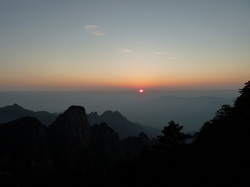
Saturday morning, we experienced a transcendent moment while drinking in the first rays of light.  Huangshan’s main attraction is its otherworldly sunrises.  How delightful it was that everyone in our hostel clamored awake at 5:30am, dressed quickly, and rushed outside to…..greet the day.  A quotidian event that most of us barely acknowledge became Saturday’s main attraction. 

Whether acknowledging it or not, everyone on that mountain that day made it a priority to cherish the gifts of their Creator.  I stood in awe of the One Above as the reddish pink orb crested the misty horizon.  For those few moments, when a relative hush came over everyone and the sun gently crested the clouds, all of the frustrations of the past couple months faded away.  Saturday's sunrise put everything in perspective.

After enjoying such an otherworldly occasion, we began our venture down the mountaintop.  We put one foot in front of the other for four hours, scarfed down another lunch (our first real meal since lunch the day before), and made our way back to the pick-up point for the bus back to Hangzhou.  I’ve never enjoyed a shower so much as the one I had Saturday night back in our comparatively clean dorm.  We celebrated our adventure with pizza and beer at a local Western restaurant, and crashed early for one of the best nights of sleep I’ve had in China. 

I’m still processing our mountaintop experience (pun intended :).  I’m sure reflections from the trip will emerge in subsequent blog posts, but for now, I was grateful for a last minute escape to nature, the opportunity to feel invigorated while hiking, and a reminder that our Creator blesses all people with the beauty of places like Huangshan. 

* see the eponymous post from September :)

Picture
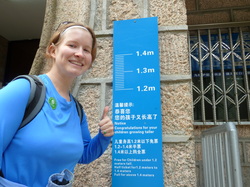
The caption in Chinese and in English reads, "congratulations on your children growing taller."  I suppose this is a consolation prize to parents who have to pay the full $40 entrance fee for their youngyins! 

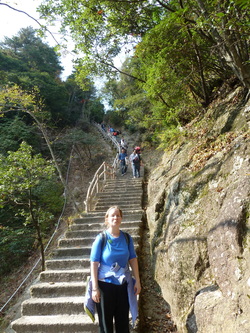
Picture
This is what two hours of hiking/stair climbing looks like.  But still smiling.....! :)

Picture
PLEASE no more stairs......! :) 

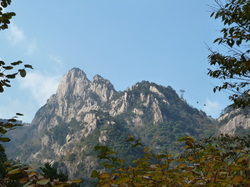
Picture
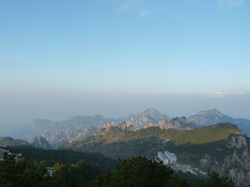
One of Huangshan's many beautiful vistas. 

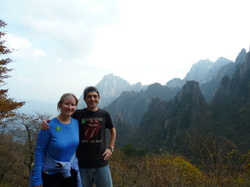
Picture
Our mountaintop experience. 

Picture
The view from the bottom of the western entrance. 

Picture
Good morning. 


Well, it’s finally happening:  autumn is upon us here in Hangzhou.  Within 24 hours the air has chilled, the scarves have emerged, and all of a sudden, I’m craving pumpkin pie and baked apples.  As far as I’m concerned, yesterday was the first day of this new season (no matter when the equinox is).

With the emergence of autumn, Brian and I also feel like we are moving into a new stage of life here.  Maybe, just maybe, we feel more settled (or at least as settled as we can feel in a dorm room with no kitchen facilities! :).  Our friend Jen, who has also lived abroad, wisely advised me that feeling “settled” is hard to describe or anticipate.  Perhaps the cooler air yesterday alerted me that we have also arrived at this elusive state of being without knowing it.  For us, being settled means that preparing our daily breakfast has become an ingrained habit (as opposed to laboring to decide how we keep milk with no fridge, make coffee with no drip coffeemaker, or eat cereal with no spoons or bowls).  Feeling settled means we know what to expect in our daily classes, we are comfortable with our teachers and classmates, we can figure out how to get from point A to point B in this city, and we recognize people in church each week.  We are aware that there is still much for us to learn, yet we no longer have the wave of confusion and fear threatening to overwhelm us.  Perhaps feeling settled means that the waves of utter and terrifying bewilderment have subsided. 

This fresh season also holds promise for us.  A new friend of ours is organizing a trip this weekend to a famous mountain about four hours away called HuangShan (“Yellow Mountain”).  HuangShan has apparently beckoned China’s sages, poets, and contemplatives for ages, and I look forward to crafting my own thoughts as we hike to the top, spend the night, and rise early to see what I’ve been told is one of the most beautiful sunrises in China. 

Speaking of crafting thoughts, I sense that my thought patterns have changed significantly since I’ve been here.  Though it has not been an easy process to be stripped of many comforts and luxuries of the US, we’ve also been stripped of many distractions.  I am grateful to relinquish bad habits of mindless internet surfing since our internet is so limited here.  I’ve been forced to become a more focused and patient person since everything takes so much time and effort.  Yet in that forced discipline, perhaps I’ve gained the stamina and drive we need to study this completely different language and culture.

There’s been a lively conversation in the US the past few months about how the internet is affecting our thought patterns and neurological wiring.  Apparently recent studies have concluded that our attention spans are becoming increasingly scattered.  We are bombarded with information:  music, facts, and images.  Subsequently, we don’t know how to respond.  People click one link online, read a few seconds, and then click another link (often not even realizing what they are doing).  I can’t haphazardly surf the internet here because it takes so long to load each page—I’ve tried to click with reckless abandon, yet find myself stuck when the internet refuses to obey.  I am forced to wait for the page to load, but because of the lessened bandwidth, I’ve learned to enjoy each page’s information.  I’m surprised how grateful I am for the slower internet, and in general for the discipline that the challenge of life here offers us.   

Those are my new thoughts for now.  I hope I’ll have even more of them after our mountain hike this weekend.  For now, my next challenge is figuring out how I can satisfy this craving for pumpkin pie and baked apples!  While apples are bountiful, and I have a steamer that may work for cooking them, I have yet to find cinnamon…..next blog post:  cooking and food in China! :) 


As the blog posts probably reflect, our time here has been deeply humbling. We have completely depended on the charity of other foreigners who have helped us to figure out how to order clean water, obtain a student card to buy food in the cafeteria, use the buses, and set up internet in our room.  Any merits or achievements that we had in the US mean nothing here.

At this university, we are merely yet another pesky set of foreigners who can’t yet speak Chinese.  We are just another set of “big noses” (which is apparently how the Chinese view foreigners) who flail their arms strangely, trying unsuccessfully to communicate.  Our resumes mean nothing.  Try as we may, we cannot wax eloquent, pull strings, or even pull ourselves up from our own boot straps to achieve success in this country.  Believe me, we’ve tried.  It. Doesn’t. Work. 

I say all this now with a bit of gratitude and deeper awareness.  Learning how utterly unprepared we were for life here was an incredibly hard lesson, especially after living in success-obsessed DC. Everything I’ve been taught in the US about how to be an assertive leader simply leaves us empty handed.  Wearing my laurels on my sleeve here only makes me look more ridiculous than when I wave my arms to try to catch a taxi.

Our friend Sarah, who also journeyed here from DC, had an interesting observation recently.  Whether we acknowledge it or not, the US touts the assertive and proactive entrepreneur as the iconic role model. Our cowboys, stock brokers, and intellectuals alike are supposed to grab the bull by the horns and wrangle power over (and ostensibly for the benefit of) others. 

In China, by contrast, the iconic role model is the sage who listens and waits.  This person is patient, passive, and silent, yet in that time and space can hear the language of the universe.  So, after trying unsuccessfully to wave, jump, shout, and push, I’ve finally tried to listen.  And in that space of silence (well, metaphorical silence since this country is one continual car horn), I’ve heard words of wisdom I could not previously here in the US.  This Big Nose is trying to grow Big Ears.

Today’s Scripture reading actually came from Sirach, which is not a book I’m familiar with as a Protestant (for my fellow Protestant friends who may not know, Sirach or Ecclesiasticus is in a set of books called the Apocrypha that is found in the Catholic Bible).  Sirach 6:18-37 spoke directly to our current situation.  I’ll summarize a few verses here:

        my child, from your youth choose discipline, and when you have gray hair you will still find wisdom….She seems         very harsh  to the undisciplined; fools cannot remain with her.  She will be like a heavy stone to test them, and             they will not delay in casting her aside…Search out and seek, and she will become known to you,…for at last you         will find the rest she gives, and she will be changed into joy for you…If you love to listen you will gain knowledge,         and if you pay attention you will become  wise” (Sirach 6:18, 20-21, 27-28, 33). 

We are learning to listen in our language classes, where we are slowly but surely starting to understand how 22% of the world’s population comprehends the world.  We are learning to listen at church where much of the leadership is African and brings a delightful yet different perspective than what I’m accustomed to.  We are learning to listen to our classmates, many of whom would fall below us on the totem pole of influence and achievement in the US, yet have nonetheless blessed us with their insights.  And we are learning to listen to the Eternal One so that we can gain the wisdom that Sirach also sought many years ago.  Thankfully, all these groups are speaking and teaching.  We can now be part of a conversation we previously could not hear. 


Now that we have a few weeks of full-time language study under our belts, Brian and I can begin to appreciate some of the humor and power that can emerge in language learning.  We now know Mandarin phrases to get certain items we need, such as chopsticks, a glass of water, or the check at a restaurant.  We can also (for the most part) tell the taxi driver where we need to go (instead of having to rely on cards with the Mandarin phrase written on it).  It is actually very empowering to say new and previously foreign sounds, and then magically receive what we need.  

One of the other fun aspects of immersing oneself in another tongue is indulging in the feisty world of curse words.  Almost every language has them, and they often elicit the same responses of shock, anger, or sometimes even humor from speakers of the languages that produce them.  Last week, one of the Russian speakers in my class guffawed when our teacher said the Chinese word “hui,” which means “to return, to go back.”  Apparently this word sounds very similar to a wordy dird in Russian (I’m not sure which one, but I’m guessing a pretty bad one based on his reaction).  His response of shock at hearing a sound that is similar to one that is taboo in his language actually sent shock and confusion through our class.  We were all amused to learn why this innocuous sound to my English ears elicited such a reaction from him.

Another similar instance occurred when one classmate was asked to try out new vocabulary about schedules and classes.  The Chinese phrase “grammar class,” “yu fa ke,” sounds similar to, well, “yu fa ke.”  One student about busted a gut when he heard this phrase, and after a couple moments, we figured out why he was laughing.  It was quite entertaining to explain to the teacher why grammar class can be so shocking!

Lastly, we US English speakers have to catch ourselves the first time we hear Chinese speakers stuttering in speech with their version of “um, you know?”  The Chinese version of “um, you know?” sounds like a very offensive word in English that begins with an “n.”  This sound, which I only hear in the US when African-American guys are taunting each other, sounds quite strange coming from diminutive Asian girls chatting on the sidewalk! 

Well, now I must “hui” to studying for “yu fa ke.”  I’ll leave you with the Chinese phrase for goodbye, “zai jian,” which as far as I know, does not sound like a curse word in any language.  So zai jian for now!  :)


I am realizing more and more how I can’t help but oscillate between fascination and frustration with this country (and I know the blog posts reflect this).  Fortunately, the tide does seem to be turning for us.  We are becoming more comfortable with navigating our daily errands and tasks (i.e. we are proud we bought our train tickets by ourselves at a local kiosk to go to Shanghai—we could not have done that when we first arrived here).  We are also slowly but surely building a community here with our classmates and church friends.  It’s an eclectic community of people from all over the world and all walks of life.  I’ve learned about driving habits in Iran, television dramas in Great Britain, technology in South Korea, boarding schools in Zimbabwe, halal cuisine from Turkmenistan.  I could not have anticipated the magnitude of globalization here, or how this experience would enrich us.  We are grateful for the microcosm of the world’s people living on our campus. 

One thing we still lack, and would love to have, is positive rapport with the Chinese. It’s amazing how segregated the expat experience can be from the local population. While I won’t reflect too deeply on the reasons for the entrenched segregation (some intentional, and some happenstance), suffice it to say that I imagine we could live here for years and not have any friendships of value with any Chinese.  We obviously don’t want this.  We ardently desire to make relationships with the people of this country.  The Eternal One has given us patience in our time here, and fortunately we are cultivating patience to wait for opportunities to make Chinese friends. Gratefully, we see possible points of interaction on the horizon.  We desire to learn more about this culture (especially now that we understand just how befuddling it can seem without someone to translate it for us!), and to have personal connections to this place. 

Even though we currently lack relationships with locals, there are still aspects we love about life here:

* some evenings, we’ll hear beautiful flute music waft from the basement of our building.  While I don’t know exactly who is playing or where, the music is heaps* better than what I hear during Edification Hour!**
* someone periodically draws various traditional Chinese motifs (dragons, Forbidden City, etc) on chalkboards at the entrance of our building.  While these pictures reveal talent and pride, I wasn't sure of the source.  I discovered last week that the mysterious artist is one of the front desk attendants—we saw him lovingly drawing a new picture as we left to go to dinner one night. 
* many of the companies present in this city reflect the intriguing mix of peoples present.  Wal-Mart and Carrefour both tout all the conveniences of supermarket shopping.  H&M provides clothes with Western sizes (read:  bigger than size two :), and Gap is opening here in about a month.
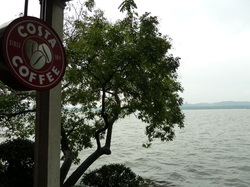
* while Starbucks has a formidable presence here, the British coffee chain Costa gives them a run for their money.  Costa’s coffee costs the same as Starbucks, yet is infinitely better in quality.  We’ve found one particular Costa right on the lake that provides ample, beautiful, and quiet space for curling in a soft chair for afternoon reading. 
* there is a scrumptious dumpling and noodle place a block away where we can stuff ourselves silly for $2/person. 
* anything goes as far as fashion here.  Seriously. 


I look forward to extending this list in the upcoming months!  But for now, $2 dumplings, uplifting chalk drawings, and a Costa café latte go a long way :). 


*apparently “heaps” is a common adjective in Australia, where my brother currently lives.
**see my eponymous post from September.


Picture
Our new favorite coffee stomping grounds (pun intended).  :)

Picture
Our little haven amidst the chaos. 


 Brian and I just returned from a blissful three days in Shanghai.  I must confess that I never thought I'd equate the words "Shanghai" and "blissful."  Before visiting this megalopolis-by-the-sea, I imagined it as a lumbering, polluted endless spread of skyscrapers.  I misjudged severely.  The city does indeed have skyscrapers (which are surprisingly beautiful), but it also has impressive museums, a brand-spankin'-new transit system, lush parks, quiet, tree-lined avenues, European bistros, a thriving arts scene, and if you look closely, you may still find vibrant old neighborhoods that produce amazing $1 dumplings.  I never thought this financial world power would have such soul. 


Picture
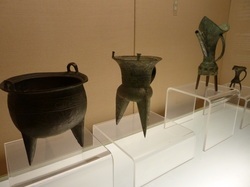
These ancient vessels are 4,000 years old.  4,000 years old!  Some scholars would say they are as old as Abraham!  These vessels are just a sampling of the treasures at the Shanghai museum. 

Picture
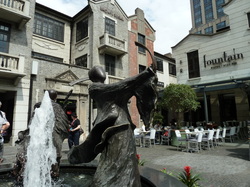
In the French Concession area.  There is shopping, eating, and strolling to your heart's content in this beautiful neighborhood.

Picture
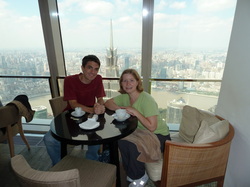
Brian and I sipping lovely lattes from the 91st floor of the 4th tallest building in the world.  91 stories!  The view was superb, and we could even see the ocean. 

Picture
A fraction of Shanghai's skyline.  Even from the 91st floor, we could not see an end to the skyscrapers.  I've never seen such growth in my life, and I was surprised by how beautiful some of the view was. 

Picture
People's Park. 

Our time in Shanghai was wonderful for many reasons:  the weather was perfect (mild temperatures, and sunny and clear skies every day), the museums were intellectually engaging, the parks were beautiful, the food was delicious, and the crowds were manageable since this is a holiday where most people return to their hometowns.  What a sigh of relief to have an adequate, new, and clean Metro system to travel from point A to point B (how do we travel around Hangzhou, you ask?  See my post from September, "Taxis and Trollers").  In contrast to Hangzhou, where we have to dodge motorbikes, flying loogies (yes I said “loogies”—it’s as gross as it sounds), and pushy tourists and peasants from the countryside who overwhelm the city (and hock the loogies), Shanghai was manageable and easy to navigate. 

Another reason why Shanghai was so nice was because we could actually enjoy ourselves, engage in cultural endeavors, and not merely fight for our basic needs.  For the past month, we have had to forage for food on a daily basis (often elbowing our way in crowds in the cafeterias or street restaurants to get seating and service), have had to fight for inadequate laundry facilities (which involved learning the hard way that the washers and dryers in our building are not only entirely too scarce, but are absolute crap), have had to fight tooth and nail to get every-single-amenity in our dorm, have had to fight for internet (this took almost two weeks with absolutely zero help from the school), have had to fight for a good night’s sleep where the noise inside the building rivals the honking, clunking, and shouting outside, have had to fight to understand our barely functional dorm bathroom with its badly placed showerhead, awful drain that clogs if the filter is on it, and sink whose “hot” and “cold” water directions are backwards, have had to fight for taxis or space on the buses (which are often late because they are stuck in traffic), and in all of this, have had to fight for our health, which has suffered stomachaches and colds.  I’ve felt like an animal the past month, competing for scarce resources for survival.  It’s been so wonderful to feel civilized in spacious museums and restaurants, and to have the opportunity to contemplate the higher things of life.  I've been able to ascend Maslow’s hierarchy of needs beyond merely the basic eat, sleep, bathe, repeat.  I’ve felt human again. 

I know I’m ultimately grateful for the experience the past month.  I now have a better understanding of a poverty mindset where people fight for scarce resources.  When people are afraid their basic needs may not be met, they turn into monsters.  They lash out at anyone who may hinder them.  I now understand that people aren’t going to be friendly or hospitable to me if they see me as competition.  Until they themselves feel secure, they will only respond (at best) with indifference and more often than not, with outright hostility.  I now understand a little more why some people on the streets here can seem so disgusting and repugnant.  And honestly, I am sure some of my own behavior the past month has also seemed repulsive when I’ve felt particularly frustrated or desperate. 

Like many other Americans, I'm currently reading the Hunger Games trilogy.  As some of you know, this young adult series features a dystopia set in the future where people can scarcely feed themselves through hunting, scavenging, and bartering.  Every year, two children from each of the twelve districts in this horrid country are brought to the capital to fight each other to the death for the sport of the wealthy capital citizens.  Out of twenty-four “tributes,” only one lives to win.  The winner will bring honor and food to his/her district back home, but the price paid is enormous.  All the tributes lose their dignity, and most lose their lives.

I’ve obviously not had to kill anyone here (praise God!  Seriously!), and I am also grateful that Brian and I have never truly been in danger.  Yet I do relate on a new level to the fight for scarce resources that is featured in Hunger Games.  Like the characters in the trilogy, I’ve had to forage for food.  My foraging is of an urban sort, which means finding reasonably priced restaurants, fruit stands, and cafeterias that have nutritious, not too greasy, and sanitary food. If I’m lucky, this food may even taste good.  I’ve had to fight for adequate housing (jury’s still out if our dorm is adequate!).  I’ve had to fight for my health, and I’ve had to fight to learn the language as quickly as possible so that we can fight more effectively.  This process has given me more discipline and determination, but it has also been exhausting.

Shanghai was such a relief because it not only allowed Brian and me a respite from the fight, but it reminded us that the scarcity mentality so dominant on our campus is not definitive of the entire country (in fact, I doubt it is dominant of our entire city, but our experience in Hangzhou has been almost completely defined by our time on the university campus).  There is a hopeful pulse in Shanghai, and I now understand why so many people have featured China as the Next Big Thing.  Our time away reminded Brian and me that the fight of this past month does not define us.  Yet it does inspire us to persevere in this season of language study.